
Mining · Coming soon
Specifying PTFE hose for mineral processing: a checklist
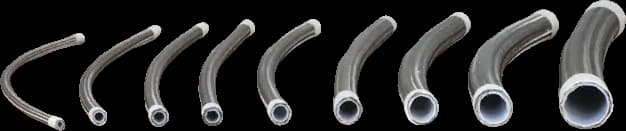
Media, concentration, temperature, pressure, bend radius, braid and ends — the seven questions to answer before a hose goes on a reagent line.
Datasheets, compatibility data and AFPL’s engineering library — with a new series written for Australian plant.
| MEDIA | RATING | NOTE |
|---|---|---|
| Sulfuric acid (98%) | A | Resistant at concentration, up to 260 °C. |
| Hydrochloric acid (37%) | A | Resistant at concentration, up to 260 °C. |
| Nitric acid (70%) | A | Resistant at concentration, up to 260 °C. |
| Hydrofluoric acid (concentrated) | A | Fluoropolymers resist concentrated HF. |
| Sodium hydroxide (≤ 40%) | A | Resistant at moderate temperatures; common CIP chemical. |
| Hydrogen peroxide | A | Suitable for CIP and sanitising duty. |
| Peracetic acid | A | Suitable for CIP and sanitising duty. |
| Acetone | A | No effect. Degrades rubber quickly. |
| Methyl ethyl ketone (MEK) | A | No effect. |
| Toluene | A | No effect. |
| Chlorinated hydrocarbons | A | No effect. |
| Molten alkali metals | D | Not compatible — attacks PTFE. |
| Fluorinating agents (XeF₂, CoF₃) | D | Not compatible. |
| Molten sodium hydroxide (high conc.) | D | Not compatible at elevated concentration. |
A = excellent, no effect · D = severe effect, do not use. Ratings at standard test conditions (typically 48 h at ambient). Mixed media, concentration and temperature change the answer.
Media, concentration, temperature, pressure, bend radius, braid and ends — the seven questions to answer before a hose goes on a reagent line.
Articles open on our global site, aftubes.com.